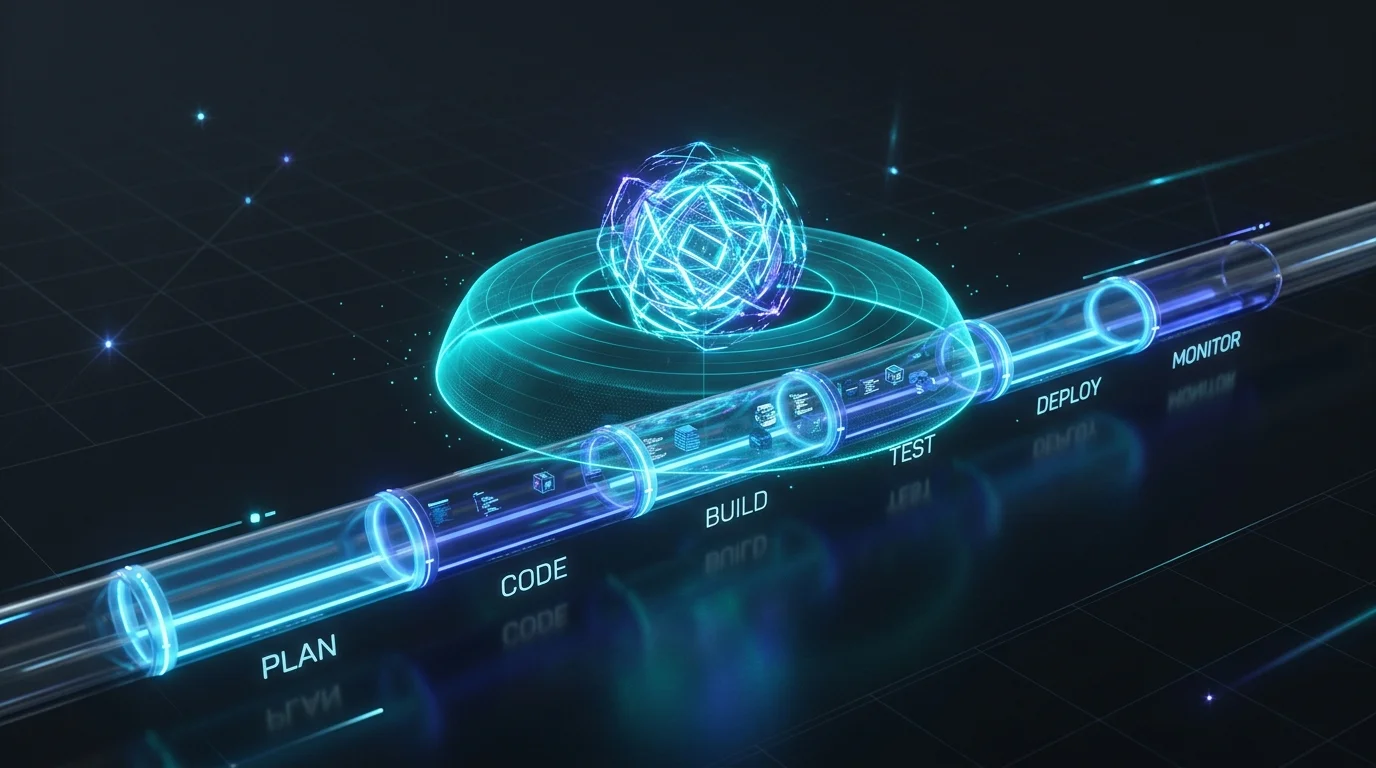
Predictive Build Risk: How We Architected an AI-Powered Layer for CI/CD Pipelines
The worst thing about a CI failure is not the failure. It is that you found out thirty minutes after you stopped thinking about the code. Here is how we built Cognix to score build risk at commit time instead.
The Broken Developer Feedback Loop
CI/CD pipelines are where most teams find out their code is broken. The problem is when they find out:
A software engineer writes code and opens a Pull Request.
The CI pipeline initiates a massive matrix of test runners, Docker builds, end-to-end integration tests, and deployment scripts.
Twenty to forty minutes later the build fails on a transitive dependency mismatch, a flaky integration suite, or config drift between environments.
The engineer, now three tasks away, comes back, reads several thousand lines of log output, and starts the cycle again.
The wasted runner minutes are the small cost. The expensive part is the context switch, which does not show up on any dashboard.
Cognix is our attempt to move that feedback to commit time.
1. The Core Architecture of Predictive Risk Analysis
Cognix does not replace the test suite. It is a triage layer between the commit and the expensive part of the pipeline, and it is wrong often enough that treating it as a gate would be a mistake.
Feature Extraction Pipeline
On push, Cognix builds a feature vector. This is cheap, typically well under a second, because none of it requires running the code:
Shape of the diff. Lines changed, deleted-to-added ratio, cyclomatic complexity delta, and whether a config file (Dockerfile, package.json, pom.xml) was touched.
Failure history. How often builds have broken in this service or directory before.
Author familiarity. How frequently this author commits to the affected package. Not a judgment of the engineer, just a signal that unfamiliar code changes break more often.
Dependency churn. Newly added or upgraded external packages.
2. Dynamic Pipeline Optimization & Intelligent Test Selection
Once the model produces a risk score, the runner adapts its plan:
Low risk, such as documentation, isolated CSS, or modules that rarely change: lint and unit tests run in parallel, long regression suites run after.
High risk, such as auth logic, migration scripts, or root build files: the tests most likely to fail run first, so the engineer usually has a real failure in front of them within a minute instead of at the end of the matrix.
Flaky tests: historical variance separates non-deterministic tests from genuine regressions, so a known-flaky suite does not block a merge on its own.
3. Shipped Impact: The Cognix Platform
Cognix runs as a set of services on Next.js and Node.js in Kubernetes on AWS. What it delivers:
A risk score on the PR within a few seconds of the push, before the developer has switched tasks.
Fewer runner minutes spent on work that was never going to fail, by deferring long suites on low-risk changes.
A failure summary that points at the failing assertion instead of a log file the engineer has to scroll.
One honest caveat: a risk score is a prior, not a verdict. Cognix reorders and defers tests. It never decides that a test does not need to run before merge.
When to Implement Predictive CI/CD
Team Profile
Recommended Approach
Small codebase (under 10k LOC, builds under 5 minutes)
Plain CI runners. Prediction saves nothing here.
Monorepo or microservices (50+ devs, builds over 20 minutes)
Risk scoring and targeted test selection
Flaky integration suites
Historical variance filtering, regardless of size
Frequently Asked Questions (FAQ)
Does predictive build analysis replace running unit and integration tests?
No. It changes the order and timing of test execution and gives feedback earlier. Every test required for production verification still runs before the merge lands on main.
How is the risk model trained?
On the organization's own build telemetry: commit metadata, test pass and fail outcomes, durations, and error codes, all from its private repository history. Nothing leaves the customer's environment, and a new installation needs a few weeks of build history before its scores are worth acting on.
Sharing battle-tested engineering perspectives on Web Development, Mobile Architectures, Enterprise AI, and Cloud Scalability from the NizSol engineering labs.
Was this technical breakdown helpful?
Your feedback directly guides our engineering editorial roadmap.
Partner With NizSol
Ready to scale your next web, mobile, or AI product?
Our team of senior architects and full-stack engineers helps fast-growing companies design, build, and deploy production-grade software with speed and precision.